
Notifications 11
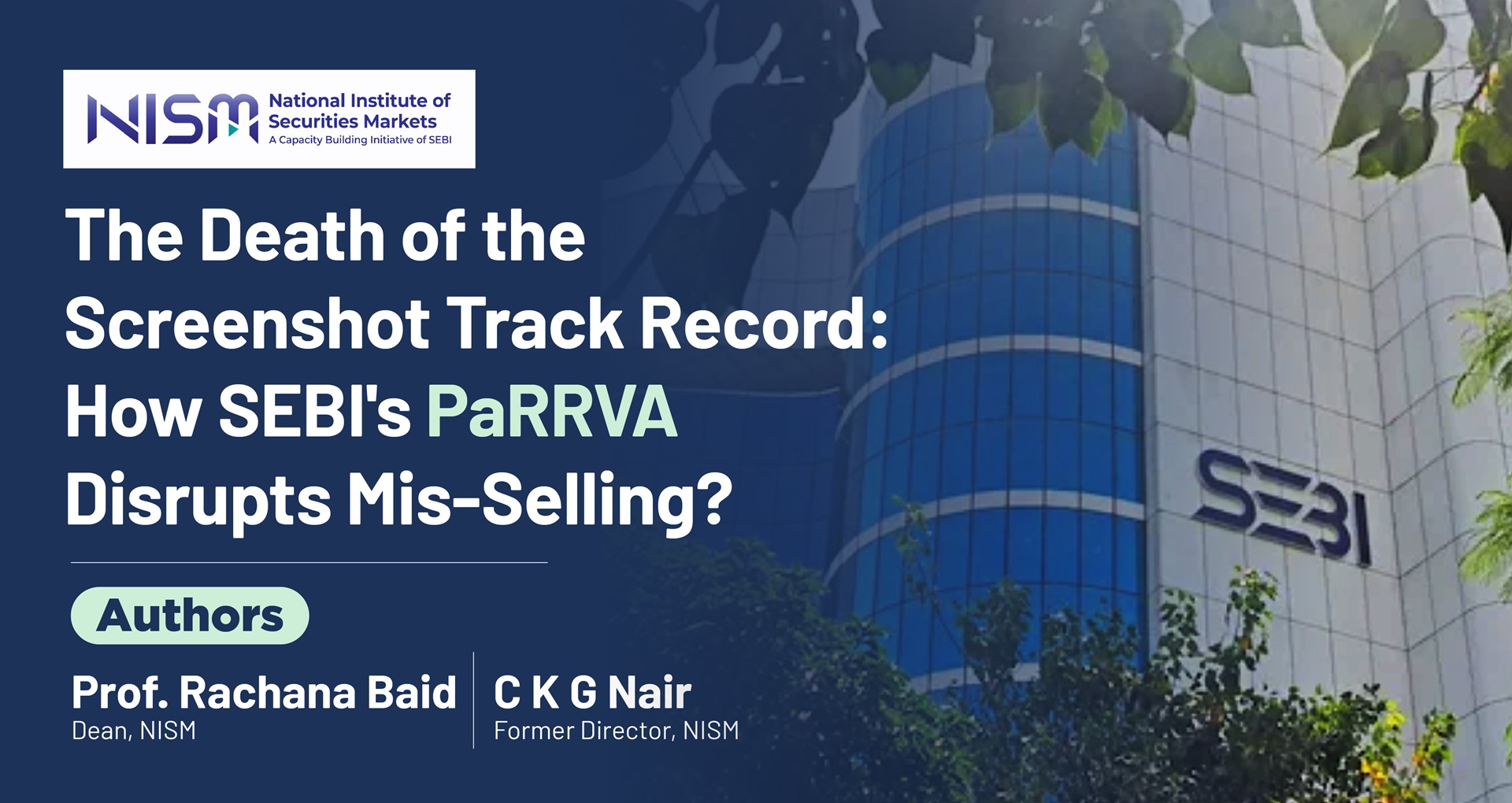
There is a familiar moment to almost all of us. It usually arrives on WhatsApp. A forwarded image or a Telegram screenshot claiming that a stock recommended has “delivered 312% returns in 9 months” or that an advisor’s “model portfolio” has “beaten the Nifty for three straight years”. The numbers look tempting especially when the geo political situation has eaten away around 10 per cent of your portfolio. There is no way to verify any of it.
If you have ever paused, tempted with your finger hovering over that subscription link, the good news is that the regulatory ground under that screenshot is shifting.
SEBI’s April 29, 2026 circular operationalises the Past Risk and Return Verification Agency (PaRRVA), with Care Ratings Limited as the recognised verification agency, NSE as the data centre, and May 4, 2026 as the date services begin. By August 3, 2026, every Investment Adviser, Research Analyst and algorithmic trading service provider who wants to show past performance must be enrolled. By May 3, 2028, only PaRRVA-verified numbers can be displayed to clients. This arrives alongside the RBI’s parallel reforms — draft directions on advertising, marketing and sales of financial products by regulated entities, aimed at preventing mis-selling through explicit consent requirements, transparency in third-party product distribution, and controls on staff incentives from third parties, set to come into effect from July 1, 2026. Together, they represent the most coherent investor-protection architecture India has ever attempted.
How Mis-Selling Actually Works — and How SEBI PaRRVA Framework Disrupts Each Mechanism
To appreciate what changes on May 4, it helps to understand the specific ways that have flourished in the absence of independent verification. There are four of them, and PaRRVA blunts each.
1- The first is survivorship bias in marketing. Let’s say a research analyst makes 100 calls in a year. Twenty are spectacular. Thirty are mediocre. Fifty lose money. The marketing material features only the Twenty. Nothing in this is technically a lie — every screenshot is a real call that really happened. Until now, no one had the data, the authority, or the methodology to demand the full ledger. PaRRVA changes this fundamentally. With NSE as the PDC holding the complete record of recommendations, verification is performed against the entire universe of calls, not the curated highlights. The forty winners cannot be shown without the hundred losers in the same frame.
2- The second is the conflation of backtests with live performance. “Our strategy returned 47% annually since 2021” — except the strategy was designed in 2026 and applied retrospectively to historical data. Backtests can get flattering because they can be constructed with the answer key in hand. A standardised verification framework forces a clear distinction between what a model predicted and what it actually delivered to real subscribers in real time.
3- The third is benchmark shopping. An advisor may compare a mid-small cap heavy portfolio to the Nifty 50 in years when mid-caps outperformed, and quietly switch to the Nifty Midcap 150 in years when large-caps led. The benchmark moves; the marketing message stays the same: “we beat the market.” A standardised verification methodology — applied uniformly across all enrolled IAs and RAs — discontinues this game. You can no longer pick your scoreboard after the match.
4- The fourth, and arguably the most damaging, is the unverified finfluencer-celebrity ecosystem. YouTube channels with hundreds of thousands of subscribers casually display return claims that have never seen an auditor. Affiliate links push paid subscriptions for advisory services on the strength of testimonials and screenshots. Once PaRRVA verification becomes the norm, the absence of verified numbers becomes itself a signal — and investors will learn that unverified is the new red flag.
Notice what each of these mechanisms shares: they all exploit the asymmetry of information between seller and buyer. The seller knows the full picture. The buyer sees only what the seller chooses to show. Mis-selling is, fundamentally, a problem of asymmetric information — and verification is the textbook remedy to reduce the problem of adverse selection. Honest advisors, who could not ethically inflate returns, have been quietly losing ground for years to louder operators making claims they could not substantiate. PaRRVA finally lets quality become visible.
The Governance Safeguard, and the Larger Architecture
One may ask: who verifies the verifier? SEBI’s circular addresses this through the composition of the Oversight Committee. The committee must include representatives of PaRRVA, the PDC, at least two intermediaries, a SEBI-recognised investor association, and an eminent individual with regulatory experience as Chairperson. Crucially, independent members must outnumber the combined representatives of PaRRVA and the PDC. This structurally guards against the verifier-capture problem that has plagued regulated industries everywhere, from credit ratings before 2008 to every audit scandal since.
Place PaRRVA alongside the broader picture. The RBI framework addresses mis-selling at the point of distribution — the branch counter, the relationship-manager call, the loan-bundled insurance policy. PaRRVA addresses mis-selling at the point of decision — when investors evaluate an advice based on its claimed track record. Together, they form a layered defence.
What Investors Should Do Now
After May 4, ask one direct question: Is your past performance PaRRVA-verified? The answer tells you almost everything. After August 3, 2026, treat non-enrolment as a negative signal. After May 3, 2028, treat the display of pre-PaRRVA performance data as a violation.
The most important thing about PaRRVA is not the mechanics. It is the philosophical shift. The burden is shifting to where it belongs: on the people selling financial products to prove that what they are selling is what they say it is. The investor is no longer the last line of defense. The investor is the person being defended.
Author: Prof. Rachana Baid, Dean – NISM | CKG Nair – Former Director, NISM
The Death of the “Screenshot Track Record”: How SEBI’s PaRRVA Disrupts Mis-Selling There is a familiar moment to almost all…
Last Updated on: July 22, 2026 The Silent Casualty of Market Chaos; How Geopolitical Turbulence Is Eroding Health, Not Just…
Last Updated on: July 22, 2026 What is Bear Market? Lessons from Bear Markets Bear markets leave marks on charts…
© 2026 National Institute of Securities Markets (NISM). All rights reserved.
